




Advertising in AI Chatbots: Early Observations and Considerations for Responsible Implementation
by Jason Snyder, Privacy Counsel, The NAI
Introduction
In January 2026, OpenAI announced it would begin testing advertising in ChatGPT.1 By March, the company had announced plans to roll out ads to all free and low-cost users in the United States.2 These announcements were met with both enthusiasm and skepticism: some of the world’s largest agency holding companies signed on to participate,3 while OpenAI’s biggest competitors positioned themselves as ad-free and ran Super Bowl commercials framing advertising as a threat to the integrity of chatbot engagement.4
The conversation around advertising in AI chatbots is now well underway and the stakes are worth understanding clearly. The central question is how chatbot advertising will account for the trust users place in these systems, from ad labeling and conversational data use to commercial recommendations and the integrity of assistant outputs.
The chatbot interface is built around a direct, ongoing dialogue. Interactions are conversational and can involve a level of contextual detail that far surpasses what users typically type into a search bar. The novelty of these interactions is precisely what makes this environment commercially attractive, and why the design choices being made right now deserve careful attention. If advertising is introduced in ways that make users wonder whether the assistant’s guidance is independent, or whether what they disclose in conversation may later become a commercial signal, the value of the medium itself is at risk. The decisions made today will establish the norms against which this medium will evolve.
What separates chatbots from traditional digital advertising environments
AI systems require enormous resources to build and operate. The revenue models that have supported them to this point, including subscription tiers and enterprise licensing,5 may not be sufficient to sustain broad, affordable consumer access over time. Advertising is therefore emerging as a natural and practical candidate for filling that gap.
In a traditional digital context, the content a user is seeking exists independently of the user. An article, a social media post, or a search result exists before the user arrives on the page to view it, and ads appear alongside the content as a separate, distinguishable layer. Users have grown accustomed to that structure and can generally recognize where the content ends and the advertising begins.
By contrast, AI chatbot users engage in what is presented as a private exchange: they ask questions, describe circumstances, and work through decisions in real time. These systems are presented as tools that can help users learn or accomplish specific tasks, reinforcing the perception that outputs exist in service of the user. The role the chatbot appears to play, that of an advisor, or an expert, or even a confidant, shapes the level of trust a user may extend to these systems. A user could be asking an AI chatbot medical questions they are nervous to ask a doctor, for financial guidance, for help navigating difficult personal situations. And because the systems are designed to ask clarifying questions and draw out context, users are often encouraged to share more as the interaction progresses.
The value of chatbots as a product rests on that trust and introducing advertising into this dynamic must take it into account. Advertising that feels misaligned with the nature of the exchange, or that causes a user to second-guess whether their inputs are shaping what they are being sold could threaten the underlying value users are getting from these products.
User expectations in this space are still forming. AI chatbot publishers and the digital advertising industry have the opportunity to shape those expectations deliberately, and a corresponding interest in doing so carefully.
What early implementations look like
As advertising in chatbot environments begins to take shape, ChatGPT offers an early and noteworthy example of a prominent chatbot’s first foray into advertising. In the free version of ChatGPT, ads are currently shown to certain users in designated placements outside of the primary response, labeled as sponsored content and visually distinguished from the system’s output.6 OpenAI has stated that ads are served separately from response generation and do not influence the answers provided to users.7
Below are a series of screenshots taken in May of 2026 reflecting early implementations of ads in ChatGPT.
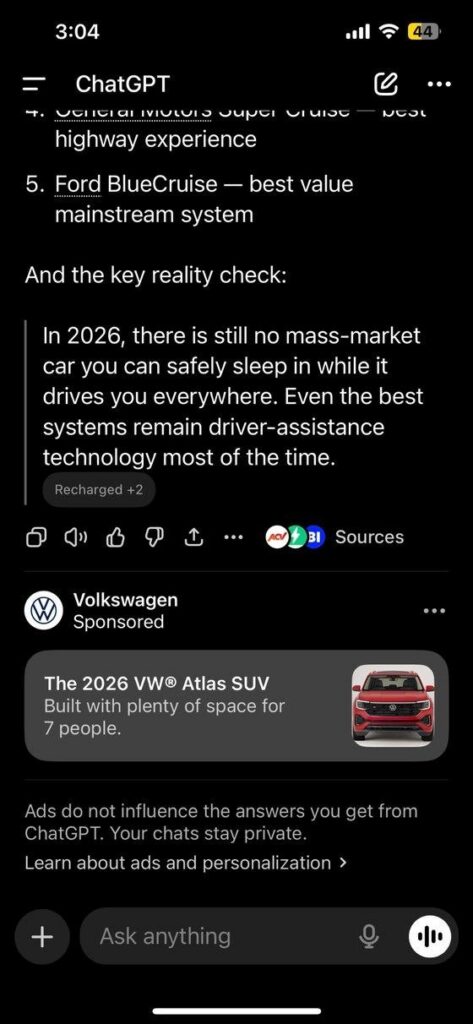
(Figure 1: A sponsored Volkswagen ad appearing below a ChatGPT response to the prompt “What are the best self-driving cars in 2026?” The ad is labeled as sponsored and appears separated from the model’s output. Beneath the ad, a line reads “Ads do not influence answers you get from ChatGPT.” There is also a link where the user can “Learn about ads and personalization.” Screenshot taken May 2026.)
Tapping the “Learn about ads and personalization” link in Figure 1 opens a four-screen onboarding sequence. Figures 2 through 5 show each screen.
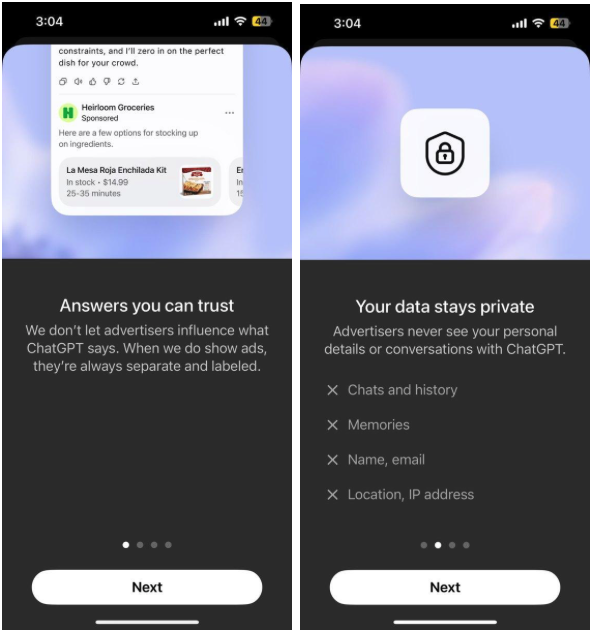
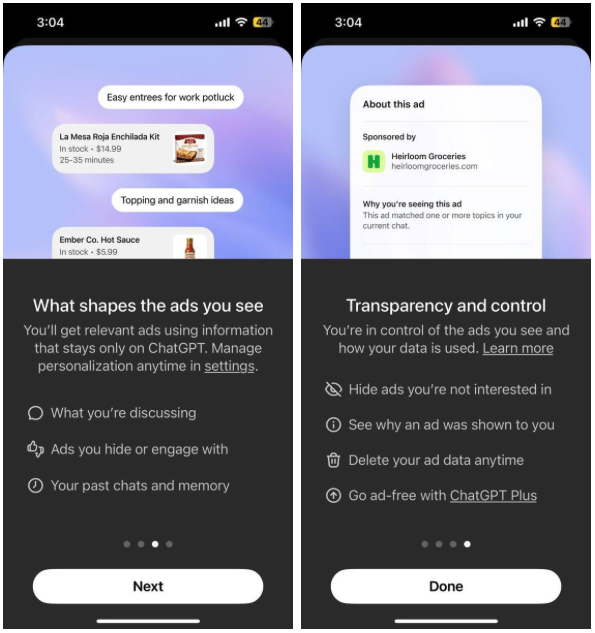
(Figures 2, 3, 4, and 5: The four-screen disclosure sequence a user sees upon tapping “Learn about ads and personalization” beneath the ChatGPT ad in Figure 1. The screens cover, in order: the commitment that ads do not influence responses; what data advertisers cannot access; what signals shape which ads are shown; and the controls available to users, including the option to delete ad data or upgrade to an ad-free plan. Screenshots taken May 2026.)
The same basic placement format appears across query contexts, though not all instances include the same disclosure elements.
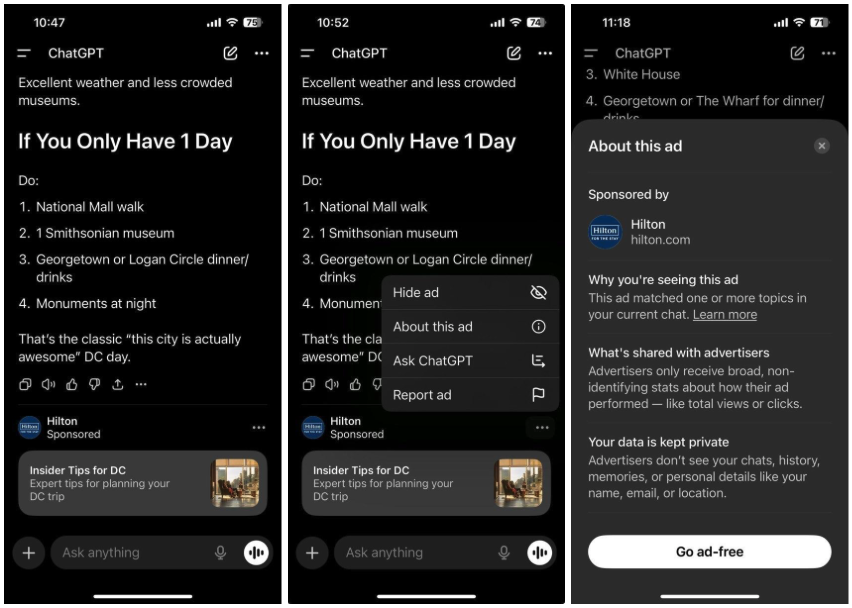
(Figures 6, 7, and 8: A sponsored Hilton ad appearing below a ChatGPT response to the prompt “What are the best things to see in Washington DC?” The ad is labeled as sponsored, and appears separated from the model’s output. Notably, the “Learn about ads and personalization” link visible in Figure 1 is absent here, suggesting it does not appear across all ad placements. Clicking on the three dots to the right of the “Hilton Sponsored” text provides the user with the options in the popup screen shown in Figure 7. That menu offers four options: hide the ad, learn more about it, ask ChatGPT a question about it, or report it. Figure 8 is the screen a user is presented with if they click the “About this ad” option in Figure 7. Screenshots taken May 2026.)
OpenAI’s ad policy currently states that it has safeguards designed to prevent ad placements in “sensitive user contexts” and “brand unsafe contexts.” Sensitive user contexts include “vulnerable user-model interactions, such as emotionally reliant contexts, mental and personal health conversations, and sensitive user journeys.” The policy separately identifies categories that are inappropriate for ads, including “child safety, cyber abuse, dangerous activities, fraud or deception, misinformation, political content, privacy, regulated goods, suicide or self-harm, terrorism, and weapons.”8
OpenAI applies additional restrictions to regulated advertising categories, stating that financial services, healthcare and medicine, and legal services ads may be allowed only from approved advertisers, with approvals reviewed manually on a case-by-case basis. Ads also are not shown to users OpenAI believes are under 18.9
Ads in ChatGPT are triggered by the content of the user’s prompt or the broader conversational thread.10 A user asking about travel options may be presented with an advertisement related to transportation or accommodations.11 In some cases this extends to prior interactions or stored preferences, reflecting a more continuous understanding of user intent.1213 Industry observers have noted that user intent is expressed more explicitly in chatbot conversations than in traditional search queries, and that this specificity has the potential to improve ad relevance and performance.14
OpenAI has moved quickly to integrate with established adtech infrastructure. Criteo, which supports targeting and measurement,15 Kargo, which is adapting creative formats for conversational environments,16 and Adobe, which is both running its own ads in the pilot and developing tools for other marketers,17 have all integrated with ChatGPT at this early stage. All three companies are NAI members that participate in the NAI’s Self-Regulatory Framework, which requires adherence to defined privacy principles and annual reviews of privacy practices. Their involvement suggests that conversational advertising is not developing entirely outside the accountability structures that already exist for digital advertising.
What responsible implementation will require
Early implementations have incorporated meaningful guardrails. Keeping ads visually separated from responses, excluding sensitive topic categories, and declining to share raw conversations with advertisers are constructive commitments. They are also early ones, and the questions they leave open will become more visible as advertising in these systems scales and integrates more deeply with existing adtech infrastructure. What follows identifies the issues that most need deliberate attention, and what responsible implementation looks like in each case.
Responsible use of conversational data
The use of conversational data for advertising purposes raises considerations that labeling alone does not resolve. While there are important differences, conversational data is in some respects similar to a personal communication, like an email or a text message. The input is something the user composes deliberately with the aim of eliciting a response, and it may be more specific and personal than many of the passively collected behavioral signals commonly used in digital advertising, such as page views, clicks, ad impressions, or app interactions.
There is some precedent for treating such content with care. California’s privacy law includes “personal information that reveals the contents of a consumer’s mail, email, and text messages” within its definition of sensitive personal information, though not when the business is the intended recipient.18 Google’s decision to move away from using Gmail content to personalize ads19 reflects a similar judgment that the substance of what a person writes could warrant different handling from other data a service holds.
This distinction matters most for separating two uses that are easily conflated. Matching an ad to the general topic of a chatbot interaction is relatively familiar contextual placement, much like using the content of a webpage or search query to determine which ad appears nearby. The more consequential question is whether what a user wrote is used to create a durable interest profile that follows the user across conversations, services, or contexts. OpenAI’s early implementation usefully reflects this distinction by beginning with the topic of the current conversation, keeping conversations private from advertisers, and limiting advertiser reporting to aggregated performance information, while separately treating personalization based on past chats, memory, or ad interactions as a user-controllable setting.
The baseline should reflect the expectations users bring to these interactions. In a setting whose primary purpose is presented as assistance, the default for advertising use of conversational content should favor derivation and minimization over retention. That means using the least specific signal needed to support relevance, limiting the persistence of advertising topics, avoiding the conversion of sensitive conversational content into lasting targeting categories, and providing meaningful controls over whether past chats or memory may be used for ad personalization.
Meaningful consumer control
Users should have the ability to understand and shape how their data is used in connection with advertising. That means knowing what data informs the ads they see, how long it is retained, and whether it is used to inform targeting in other contexts or by other parties. It also means having access to mechanisms that make exercising those choices as easy and straightforward as possible, whether through controls the platform provides directly or through recognized opt-out signals. Controls need to be both technically available and practically accessible to be meaningful.
Clear and durable content exclusions
Topic-based exclusions are a constructive starting point, but their scope and durability matter as much as their existence. This is especially true where policies rely on contextual judgments rather than categorical bans. Commitments to exclude sensitive or regulated topics from advertising are only as meaningful as the definitions behind them and the consistency with which they are applied. Restrictions that depend on loosely defined terms like “emotionally reliant contexts” and “sensitive user journeys” would benefit from clearer definitions because those terms carry significant weight in determining when ads may be shown. How edge cases are handled, whether exclusions hold as the system scales, and whether those commitments are maintained under commercial pressure are questions that deserve detailed explanations. A user who has shared something sensitive in a conversation needs to be able to trust that the exchange will not become an advertising signal in the future.
Transparency and legibility
Where financial relationships shape what users are shown or recommended, users should have a clear and legible basis for understanding that relationship. This should apply both to standard ad placements and to affiliate and commerce arrangements, where the commercial relationship is less visually apparent than a traditional ad unit. A recommendation that appears to reflect the system’s honest assessment but is influenced by an undisclosed financial relationship would not be simply an unlabeled ad, but a distortion of the guidance the user came for. The operative question in both cases is not whether advertising is technically disclosed but whether a user encountering sponsored content actually understands it as such. That standard should inform label design and placement decisions, and existing disclosure frameworks borrowed from other digital environments may need to be modified to the chatbot interface. The discrete ad unit in the current ChatGPT pilot is a reasonable model for the labeled-placement case (see Figures 1-8). It is marked as sponsored and set apart from the response, with a short explanation of why it appeared and controls for managing it. Those elements do not yet appear uniformly. The “Learn about ads and personalization” link visible beneath the ad in Figure 1 is absent from the placement shown in Figure 6, and a disclosure a user only sometimes encounters does less to build durable understanding. Where those elements are applied consistently across placements, they reach past the technical disclosure toward the level of understanding this standard calls for.
Preserving output integrity
Commercial content should not influence, or appear to influence, the system’s core responses. This is the principle on which everything else depends. Users come to these systems for guidance they can rely on, and the credibility of that guidance rests on its independence. A response that is commercially shaped but presented as objective assistance undermines the very thing that makes these systems worth using. As chatbot advertising matures, maintaining a clear and verifiable separation between what the system recommends and what it has been paid to surface is the condition on which the long-term value of the medium rests.
Conclusion
Advertising in AI chatbots is arriving while users are still forming their understanding of what these systems are and what relationship they have with them, and before meaningful regulation has taken shape. The choices being made now are likely to define expectations for this medium for years to come.
OpenAI has already made commitments that demonstrate attention to what the environment requires. Separating ads from model outputs and declining to share raw conversations with advertisers are meaningful starting points. But the questions those commitments leave open will matter more as advertising in these systems scales: how inferred data travels across sessions, what disclosure affiliate relationships require, and whether a label that satisfies a technical requirement is actually legible to a user at the close of a personal exchange.
The clearest illustration of what is at stake is also the easiest to overlook. A user who asks a chatbot for help choosing a financial product, a medication, or a service provider is extending a degree of trust that has no real equivalent in other digital advertising environments. If that user later comes to believe that the guidance they received was shaped by commercial considerations they were unaware of, whether or not that belief is accurate, the damage to the medium will not be easily repaired.
The core tenets for building that trust responsibly already exist. The industry should apply them now, while the norms for this medium are still being written.
- OpenAI, Our approach to advertising and expanding access to ChatGPT (Jan. 16, 2026). ↩︎
- OpenAI to introduce ads to all ChatGPT free and Go users in US, Reuters (Mar. 21, 2026). ↩︎
- ChatGPT’s ads have the industry excited, but insiders are frustrated, CNBC (Mar. 20, 2026) (reporting that WPP, Omnicom, and Dentsu participated in the test program, with some brands committing between $200,000 and $250,000). ↩︎
- Anthropic Rejects Ads in Claude, Takes Aim at ChatGPT in Super Bowl Campaign – Communicate Online, Communicate (Feb. 5, 2026). ↩︎
- Risky Business: Advanced AI Companies’ Race for Revenue, Center for Democracy & Technology, AI Governance Lab (Jan. 2026). ↩︎
- I Asked ChatGPT 500 Questions. Here Are the Ads I Saw Most Often, WIRED (Mar. 27, 2026). ↩︎
- Our approach to advertising and expanding access to ChatGPT, OpenAI, (Jan. 2026) (stating that “ads do not influence the answers ChatGPT gives you” and are “always separate and clearly labeled”). ↩︎
- Ad policies | OpenAI (last accessed June 9, 2026.) ↩︎
- Ad policies | OpenAI (last accessed June 9, 2026.) ↩︎
- See, e.g., I Asked ChatGPT 500 Questions. Here Are the Ads I Saw Most Often (WIRED) (noting that ads were “tailored to the general topic of my question” and influenced by “the topic of your question as well as your past chats”); see also Programmatic Ads Are Coming to AI Chatbots (AdExchanger) (explaining that chatbot ads are served based on analysis of “the content of a conversation” to determine the best fit). ↩︎
- I Asked ChatGPT 500 Questions. Here Are the Ads I Saw Most Often WIRED (Mar. 27, 2026). ↩︎
- Id. ↩︎
- US privacy policy | OpenAI, OpenAI (May 18, 2026). ↩︎
- Programmatic Ads Are Coming To AI Chatbots | AdExchanger, AdExchanger (Dec. 9, 2025). ↩︎
- OpenAI to introduce ads to all ChatGPT free and Go users in US | Reuters, Reuters (Mar. 21, 2026). ↩︎
- Kargo Announces Integration with ChatGPT, Unlocking Access to Emerging AI-Native Advertising Opportunities, Kargo (May 5, 2026). ↩︎
- Adobe partners with OpenAI to test Ads in ChatGPT, Adobe (Feb. 9, 2026); Performance marketing enters the conversational era with ChatGPT integration., Adobe (May 5, 2026). ↩︎
- CCPA 1798.140 (ae). ↩︎
- Google Says It Will No Longer Read Users’ Emails To Sell Targeted Ads, NPR (June 26, 2017). ↩︎